
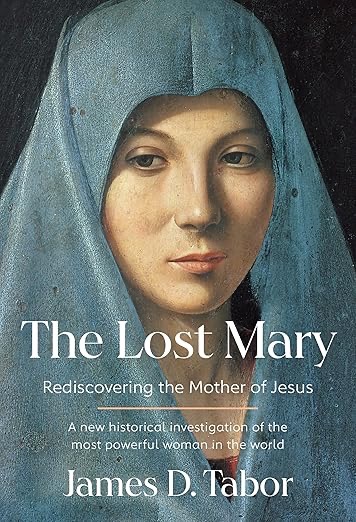
This is a long-awaited week for many of us who are passionate about Christian origins and history. The venerable and recently “retired” Dr. James Tabor’s book on the mother of Jesus is FINALLY being released. The Lost Mary: Rediscovering the Mother of Jesus will be released in the US on September 30.
Just like her son, Mary has suffered an equal amount of historical distortion over the past two millennia. Years of theology and apologetics have changed her from a young Jewish mother in a very tough social situation into a blank, obedient, pristine, mute womb. Just as her son lost every bit of his identity not useful to the faith, Mary has been transformed into a mere vessel, a means of conveyance. Just as the Church has a very inaccurate idea of who Jesus was, their picture of Mary may be even worse.
Let’s be perfectly clear. From a historical perspective, Mary would have understood her pregnancy in purely human terms, not divine. Although she was probably young, she knew how she had become pregnant. She was a teenage girl who had been betrothed to a man named Joseph but was now carrying another man’s baby.. That is the opening scene in the Mary story.
We often forget that the events detailed in Matthew and Luke did not occur in a secluded setting apart from the greater society. Mary was part of a first-century Jewish community. Her betrothed Joseph had engaged Mary’s parents and made arrangements to take her as his wife. We don’t know much at all about her family, nor the family of Joseph. What we do know is that these agreements were very serious. A marriage was a spiritual, familial, and economic contract in which the father of the bride would be compensated for his loss. The bride’s virginity was necessary for any such agreements to take place. While this is definitely odd to us today, this is standard operating procedure in the first century. Flavius Josephus underlines the seriousness of these agreements in Against Apion 2.201. Josephus notes that the punishment for such premarital violations is death “..death is invariably his punishment: no more can he avoid the same who forces a virgin betrothed to another man or entices another man’s wife.” This is how society viewed the situation in which this young woman found herself. Mary was in a bad situation and she surely would have known it.
The account believed by the Church is totally inconsistent with the norms of first-century Jewish society. Even if Jesus is truly the Messiah and is truly fathered by God, the rest of humanity of the day did not know that, nor would they have believed it. Mary would have had such a difficult time at the fringes of the community in which she was raised due to her child being illegitimate.
“We are not illegitimate children…..”
John 8:41
It is possible that a young Jesus would have wondered why his mother was not included in communal gatherings like the mothers of his friends. Mary would have had to explain to Jesus why people were treating him differently and why she was not like all the other women in town.
Mary had to endure so much as she raised her children. We know that she lost her husband sometime after Jesus was twelve, as he had taken charge of her care by the time his ministry had kicked off. This would have greatly compounded her struggles.
When we strip away centuries of theological overlay and look at Mary within her own historical world, we see not a silent icon but a young Jewish woman navigating immense social pressure and personal hardship. Her story, when set against the expectations of first-century marriage contracts and the stigma of illegitimacy, becomes one of resilience and survival. Dr. James Tabor’s The Lost Mary invites us to rediscover her in this light — not as a passive vessel of doctrine, but as a figure of strength and humanity at the very heart of Christian origins.
 The Incredible Jesus
Leave a comment