

The story of the last week of the life of Jesus of Nazareth is…..off. As the new convert reads of his trip into Jerusalem, they are filled with many questions…..as am I. Several aspects of the story do not make sense. In this series of posts, we will touch on a few of them as well as outline a wild new theory / timeline as presented by many leading historians. Buckle up.
We will start at the first event associated with the Holy Week; Jesus’ entry into the Jerusalem. Jesus had already had a following for at least three years at this point and had avoided Jerusalem for this very purpose; as being a rather “anti-authoritarian” preacher would have drawn a target on his back. (John 7:6-8) Thus upon hearing of his approach, the crowds would have been fairly excited to finally get the chance to see him.
By this point in his movement, he was seen by many to be the Messiah and was conducting himself as such. His followers and he would have all been well aware of Zechariah 9:9 :
“Exult greatly, O daughter Zion! Shout for joy, O daughter Jerusalem! Behold: your king is coming to you, a just savior is he, Humble, and riding on a donkey, on a colt, the foal of a donkey.”
-Zechariah 9:9
Therefore, proper preparations were made upon word of his arrival. Jesus arranged for a donkey to be brought to him so that he may enter the city in the manner outlined in the prophecy.
As they approached Jerusalem and came to Bethphage on the Mount of Olives, Jesus sent two disciples, saying to them, “Go to the village ahead of you, and at once you will find a donkey tied there, with her colt by her. Untie them and bring them to me. If anyone says anything to you, say that the Lord needs them, and he will send them right away.”
“The disciples went and did as Jesus had instructed them. 7 They brought the donkey and the colt and placed their cloaks on them for Jesus to sit on.”
Matthew 21:1-3, 6-7
Jesus then entered the city to the crowds of Hosannah yelling crowds.
So what about this story does not jive with the common timeline of the Holy Week? The problem lies in the presence of the palm-fronds and the Hosannahs. Given his surprise appearance, there was not time to have cultivated them for the occasion so they must have been readily available. There is only one time of the year in which palm-fronds are cultivated and the people shout Hosannahs; the Jewish holiday of Sukkot / Tabernacle.
Sukkot is a Jewish festival lasting seven days and could be loosely described as a “harvest festival.” It is one of their more important festivals that would require a Jew in Jesus’ time to make a trip to the temple. During this holiday, a small “hut” or sukka is constructed after the temporary huts used by the workers during the harvest process and meals are consumed therein. (Sukkot being the plural of sukka in Hebrew.) The end of each day is marked by the waving of “four species”. One of which being the Palm-frond together with Citron, Myrtle and Willow. (Leviticus 23:40) On the seventh day, Hosannahs are said as the members circle the synagogue seven times while waving the fronds. Not much differs from the time of Jesus until now in the celebration of Sukkot. As such, Palm-fronds are only readily available to people during the festival.
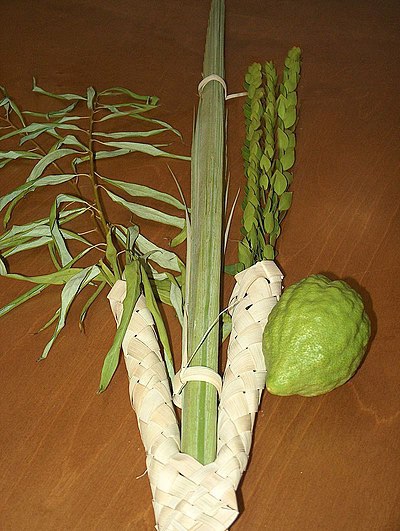
While not expressly stated, it is analogous to a person observing that as they entered an area, it was awash in orange and black decor with Jack-o-lanterns placed on surfaces. To any American, they would know that the person was describing October / Halloween. Sukkhot / Tabernacle is very much recognisable to Jewish people both then and now. Thus according to this theory, Jesus probably entered Jerusalem in September of the previous year: 29 C.E..
In addition to the above inconsistency, this episode raises another big question. Prior to his entrance into Jerusalem (whether at the end of March or September of the previous year), Jesus was afraid of entering the city knowing that nothing but trouble would await someone like him. He had already drawn the attention of the both the Jewish and Roman authorities for years starting with his association with the participation in the ministry of John the Baptizer. Knowing this, why didn’t the either the Roman authorities nor the Temple take action at such a provocative display? Entering the city in that manner was an announcement to all that he was the King of the Jews and would’ve been enough to lead to his arrest. After all, festival times in Jerusalem were extraordinarily tense and no shenanigans were permitted as the city was bursting at the seams with pilgrims. Why was this ignored?
We will take a look at this in the next installment as we examine his disruption of the Temple.
 The Incredible Jesus
Leave a comment