
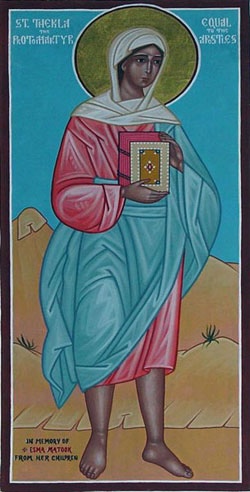
For as long as anyone can remember, Mary the mother of Jesus has held the position of the highest revered woman of the Church. By sheer volume, more prayers are said to her than any other person; including Jesus. In the early Church however, there was another woman who contended for that honor. Thecla.
The story of Thecla is found in the Acts of Paul and Thecla. Although denied entry into the canon at the Council of Nicaea, it was a widely distributed account and was read in the first couple centuries of the Common Era. Before any of my fellow nerds pipe up yes, it is known to have been forged. It is an example of pseudepigrapha ; a work written in the name of another (usually a more well known) author. Regardless of the actual authorship, it is a product of its times and a reflection of the attitudes that were present during this stage of the developement of what we today know as Christianity. It is believed that the author recorded an already known account in the name of Paul the apostle in order to give it the weight he believed it deserved.
In the Acts of Paul and Thecla, the apostle appears to preach a far more ascetic message. It almost perfectly outlines many of the ascetic practices still present today. The story of Thecla revolves around the renunciation of sexuality; those who lived a life of chastity would be saved. This is not wholly unkown in Pauls canonic teachings as he often speaks of chastity and actively discourages people from getting married; advising to do so only if they could not control their sexual urges. (1 Corinthians 7:7-9) While a mild form of ascetism was present in his ministry as recorded in the New Testament, what he was preaching in the Acts of Paul was quite a bit more extreme.
5 And when Paul entered into the house of Onesiphorus, there was great joy, and bowing of knees and breaking of bread, and the word of God concerning abstinence (or continence) and the resurrection; for Paul said:
Blessed are the pure in heart, for they shall see God.
Blessed are they that keep the flesh chaste, for they shall become the temple of God.
Blessed are they that abstain (or the continent), for unto them shall God speak.
Blessed are they that have renounced this world, for they shall be well-pleasing unto God.
Blessed are they that possess their wives as though they had them not, for they shall inherit God.
Blessed are they that have the fear of God, for they shall become angels of God.
6 Blessed are they that tremble at the oracles of God, for they shall be comforted.
Blessed are they that receive the wisdom of Jesus Christ, for they shall be called sons of the Most High.
Blessed are they that have kept their baptism pure, for they shall rest with the Father and with the Son.
Blessed are they that have compassed the understanding of Jesus Christ, for they shall be in light.
Blessed are they that for love of God have departed from the fashion of this world, for they shall judge angels, and shall be blessed at the right hand of the Father.
Blessed are the merciful, for they shall obtain mercy and shall not see the bitter day of judgement. Blessed are the bodies of the virgins, for they shall be well- pleasing unto God and shall not lose the reward of their continence (chastity), for the word of the Father shall be unto them a work of salvation in the day of his Son, and they shall have rest world Without end.
Acts of Paul 5-6
A woman who was engaged to be married called Thecla was in the audience and was apparently very moved by Paul’s message. She sat hanging on to his every word for three days. Eventually, her mother contacts her soon-to-be husband to intervene and fetch her from the presence of this interloper but he is unable to draw her away. She was very ,very taken with Paul.
The husband (Thamyris) gets angry and basically takes Paul into custody and presents him to the local magistrate for trial. I would imagine that more than that occured. As a man, I would imagine I would have more than prosecution in mind if my fiancee became obsessed with a holy-man preaching absolute abstinence….especially if I lived in a highly patriarchal society in which my entire family depends on my ability to have sons. I am sure there was some physical persuasion involved in his arrest…….and some colorful insults as well. Certainly Paul wouldve…..or shouldve been expecting this sort of reaction.
Paul is thrown into jail where he is probably safer than being left outside in the street full of angry married men. Thecla bribes her way past the guards and sits at her new teacher’s feet “kissing his bonds” (Acts of Paul 18). This was an extremely risky move. Women of the time were not free to pursue their own passions and this wouldve been looked upon as adultery. More than likely (just as now), it would be assumed that they were engaging in sexual acts and the public wouldve acted against her. Paul was in peril as well. While normally, he would have to worry about the wrath of the husband affected, in this case he would have to worry about the wrath of ALL the husbands as he was trying to convince ALL their wives to remain chaste. Eventually, Thamyris finds Thecla in the cell embracing her teacher.
After trial, Paul is whipped and banished but Thecla is condemned to death via burning at the stake. (Something her own mother had recommended. Thanks Mom!) Luckily for her, God saw the blatant sexism on display with this disproportionate sentence and when she was on the pyre, a thunderstorm came and put out the fire; allowing her to escape.
Where would one expect her to go? If it surprises you that she tracked down her teacher Paul and ran directly to his side in Antioch then you are not paying attention. Paul however, is not willing to baptize her as he is nervous she will succumb to her womanly desires at some point and embarrass him. She even offers to live from that moment forth “as a man” by cutting her hair and dressing the part. He doesnt go for it. While Paul may not want her there, a prominent citizen of Antioch does desire her presence………badly.
This prominent citizen tries to bribe Paul for alone time with Thecla but Paul, as a right gentleman, denies even knowing her. At that, the rich man tries to force himself upon her. She fights him off and embarrasses him horribly in full view of the crowd which lands her in jail. (Again, those times werent great for women.) This time, her fellow women seemed to be on her side but it didnt matter. Once again, she is dragged to the magistrate who promptly condemns her to death. This time to be mauled and eaten by beasts in the arena.
As she is being led to the arena, the women of the area cried out about the injustice of the sentence. Even the governor’s wife was horrified. Having recently lost her own daughter, she was especially sympathetic to Thecla. None of this managed to sway the governor and at the arena, the sentence was carried out.
When the first beast was loosed on her, it calmly walked up to and licked her like a dog does to its owner. Astonished, the beast keepers in charge of the execution loosed yet more beasts to kill the poor woman. The first beast springs into action and fought off each successive horrible beast set upon her to shred her apart. There was a series of vicious animals unleashed to eat her but none of them managed to lay a claw upon her.
In another area of the arena, she spotted a large vat of water containing seals known for their fierceness. Determined that she went to go immerse herself in said vat so that she may finally be baptized (as Paul had refused to do so.) “In the name of Jesus Christ, on this final day I am baptized!” – Acts of Paul / Thecla 34. As the women in the audience cried out begging her not to enter the vat, lightning (or some power from above) struck the vat, killing the man-eating-seals (apparently there are such creatures.) She then immersed herself safely, gaining the baptism she had longed for. There were other perils but they ended the same way; she was protected by the divine hand of God.

With so many abject failures on the part of the governor and his beasts to rid themselves of Thecla, he eventually yields to his wife and the women of the crowd and releases her. She was wet and smelling of fried seal but otherwise unharmed. I can’t imagine thought that seal-water smells too great but in those days, people had different standards.
The women of the population as well as the governor’s own wife were supporting Thecla by this point and each thwarted attempt to execute her made his actions seem ever more unjust. Eventually, he gives up and releases her to go about her business. No harm no foul, I guess.
Now baptised, she dresses up as a man and sets off once again searching for Paul. When she finally finds him, rather than refuse her (or refuse even to know her, like last time) he bids her to carry the word to the masses as he does.
While not exactly a feel-good story to us in this age, it certainly was to the people of the time. It is actually deceptively feminist in its message. She took her sexuality back; it was no longer the possession of her fiancee. She did not cave to the punisment and she suffered for her convictions; the control over her own soul. Paul, her beloved teacher doesnt treat her much better when he behaves at first as one would expect of a first century man. Women were said to not be able to handle such responsibility. Thecla then goes and endures trials no mere male could ever survive, demonstrating that not only are women just as able, they have the favor of God when doing so. In taking back her identity and standing firm in her faith, she defeated the patriarchical norms of her day. I am sure that it is no longer a mystery to anyone why later, a more-organized church looked instead to Mary; she reamined submissive and obedient.
Today she is known as St. Thecla of Iconium. She is mainly venerated in the Eastern Orthodox churches as the Roman variety did not find enough historical evidence for her existence. Sadly, her story and even this whole book were nearly lost to history after the church’s discouragement of those books not included in the canon. Whether the Roman Church is correct in its assessment of Thecla’s historicity does not really matter. This story was widely believed in the early church and spread along with the individual gospels at the time.
Please do take the time to read it for yourself. I left a whole bunch of stuff out of it that serves to give the story some human depth. The Acts of Paul and Thecla are available online HERE. It is amazing to connect with early Christianity through its early writings such as this one.
 The Incredible Jesus
Leave a comment